Ruislip is the Metro-land suburb that was drawn before it was built — and the one Betjeman never filmed
Most London suburbs happened. This one was won in a competition, approved by a government board, and only then built. Which is why a coach behaves differently here than it does three stops down the line.
Ruislip in 1891 had 1,836 people in it. By 1931 it had 16,042. Almost nothing about that jump was accidental, and the difference between Ruislip and the suburbs either side of it is that somebody drew the whole thing first.
The railway arrives, and one landlord owns everything
The Harrow and Uxbridge Railway opened its line on 4 July 1904, and at first Ruislip was the only intermediate stop on it. The Metropolitan Railway worked the line from the beginning, bought the company in 1905 and converted it to electric traction. Eastcote followed in 1906 and Ruislip Manor in 1912, opening as a halt before being rebuilt as a proper station in the 1930s. Later, and from a completely different direction, Ruislip Gardens opened on the Great Western and Great Central joint line in 1934, and the Central line reached it in 1948. Main line trains stopped calling in 1958.
What made Ruislip unusual was not the trains. It was the landlord. The manorial estate here belonged to King’s College, Cambridge, which by 1900 had worked out what the railway was about to do to the value of its fields, and spent the next few years buying up and consolidating what it did not already hold. So when the moment came, one owner controlled most of a parish, and could deal with the council as a single party.
A competition, and a plan approved by the government
In 1911 the college and the local authority jointly ran a town planning competition. The plans submitted by A. and J. Soutar were adopted as the basis for the development of some 6,000 acres of the parish, and were finally approved by the Local Government Board in 1914.
That sentence is easy to skim past, so it is worth slowing down on. Statutory town planning in England had only become possible at all with the Housing, Town Planning, etc. Act of 1909. Ruislip used the new power almost immediately, on a scale most places would not attempt for another generation. Whatever you make of the result, the shape of the place is not an accident. The layout was drawn, judged in a competition and signed off by a government board before most of the houses existed. Ruislip is a suburb with planning permission for its own street plan.
“Metro-land” arrives a year later
The word itself came from the railway’s marketing department in 1915, when the Met’s Guide to the Extension Line was renamed the Metro-land guide. It was published annually until 1932, the Met’s last full year of independence, and in 1919 the company set up Metropolitan Railway Country Estates Ltd to build houses along its own line. Ruislip is squarely inside that world. It is the Metro-land argument — countryside, a season ticket and a semi — carried out with a surveyor’s plan rather than a poster.
And yet when John Betjeman made Metro-land for the BBC, broadcast on 26 February 1973 and directed by Edward Mirzoeff, he went out along the main line: Neasden, Wembley, Harrow, Pinner, Moor Park, Croxley Green, Chorleywood, Amersham, Quainton Road, Verney Junction. He never turned left at Harrow-on-the-Hill. The Uxbridge branch, and Ruislip on it, is not in the film. The most deliberately planned Metro-land suburb of the lot got no camera at all, which is probably why it is still the least fussed-over.
You can still read the whole story off one building. Ruislip station is Grade II listed — 1904 for the Harrow and Uxbridge Railway, modified in 1928 by the Metropolitan Railway, buff brick with orange bands, with its 1904 signal box still standing at the end of the up platform. Historic England calls it “an extremely unaltered Metropolitan station for the period… the best preserved of its country stations”. A country station, in London, in zone 6.
What all of this does to a coach
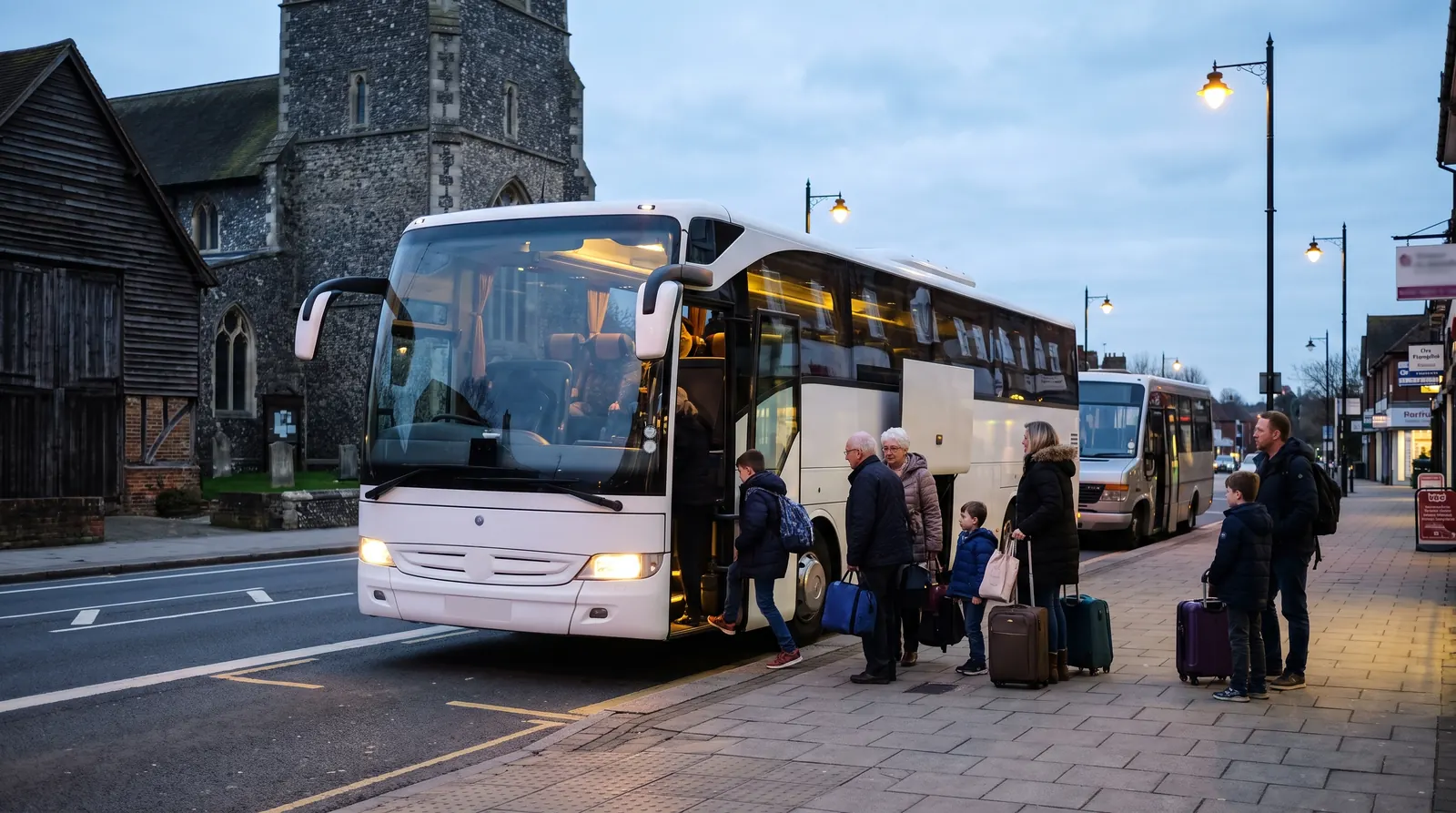
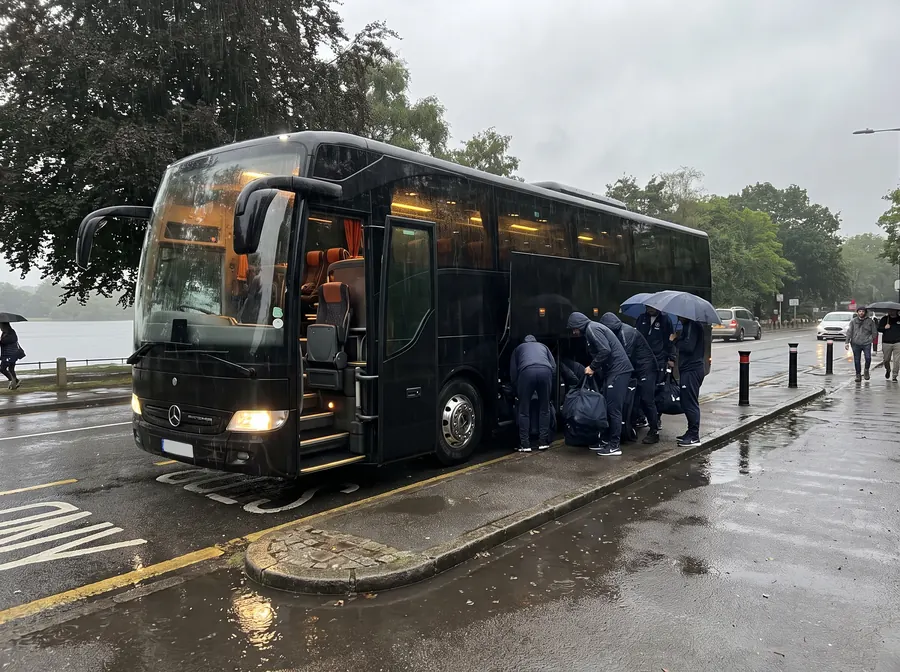
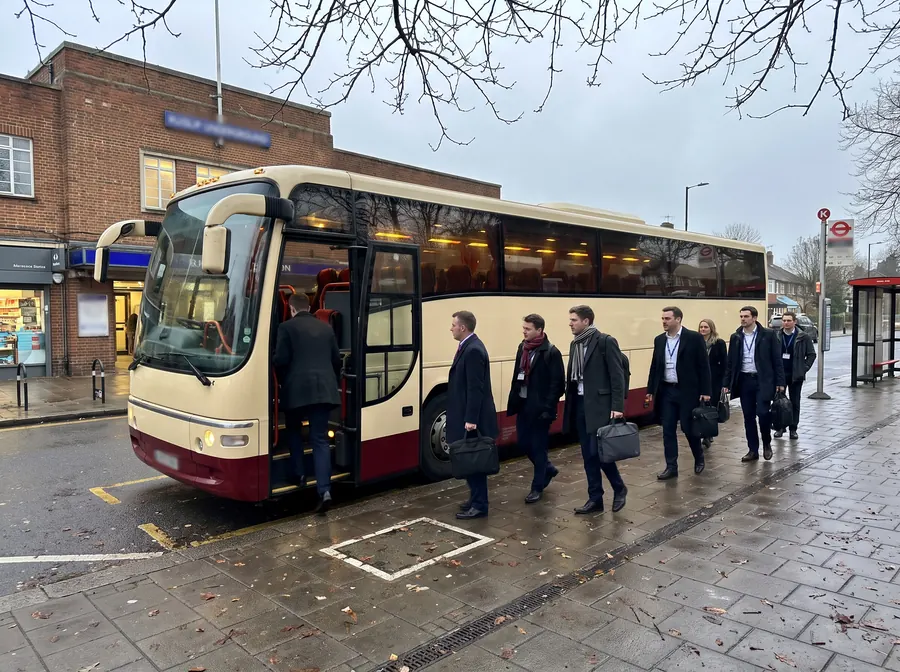
Quite a lot, as it happens. A planned residential grid is a lovely place to live and an awkward one to put a twelve-metre vehicle into: the avenues curve, the junctions are tight, and there is nowhere that was ever intended for a vehicle that size to stand. Meanwhile the things groups actually come to Ruislip for — the woods, the lido, the barn — all sit at the edge of the built-up area and are all reached on foot. The Lido’s two car parks are barriered at two metres. Manor Farm has pedestrian entrances only. Not one of the three has a road a coach can drive in on.
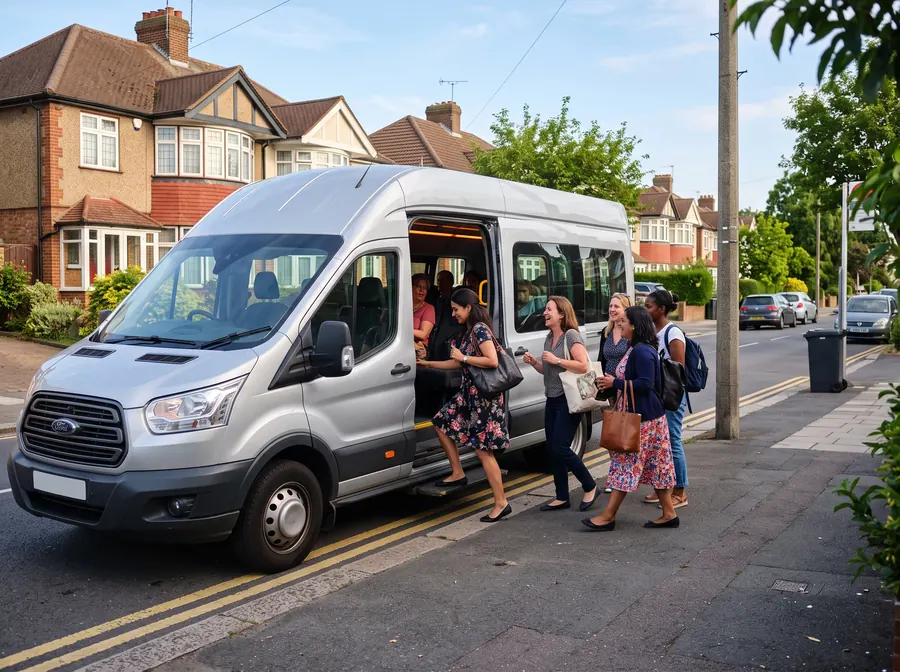
So the pattern of a Ruislip job is almost always the same: pick up at the door, set down at the edge, walk the group in, and take the vehicle away until an agreed time. It is not a workaround. It is what the town was drawn to do.
Tell us the destination as well as the number of people. In a suburb this deliberately planned, the destination decides the vehicle, and it usually decides on the smaller one.